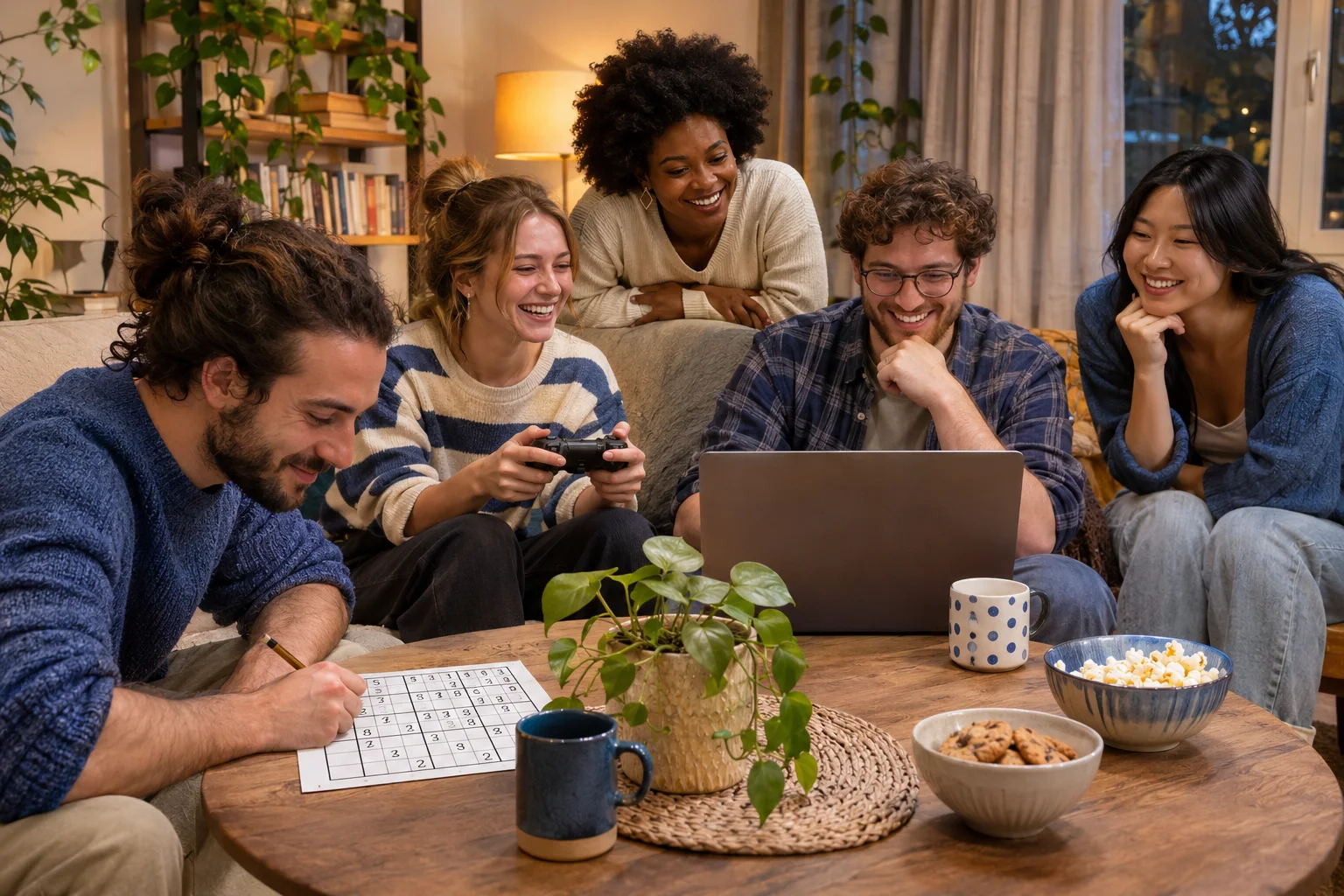
Gaming can be a wonderful excuse to retreat into solitary hibernation! Some evenings, all you want is to sit down with an especially spicy Sudoku, a single-player RPG, or a building game that'll ask you to spend three blissfully uninterrupted hours deciding where to put a bus route.
No teammates. No headset. Nobody asking why you haven't revived them yet.
Lovely!
Yet, there's something about playing games that makes it really difficult to keep them to ourselves. When you finish that fiendish final round of The Witness, what's the first thing you do? Tell your fellow gamers how long it took.
Be the first one out of your friends to triumph over Malenia in Elden Ring? You screenshot it, right?
Even those titles that are designed for solo gaming somehow end up with global communities attached to them. Have you seen the subreddits for Stardew Valley or The Sims? They're practically social clubs!
When did playing games become such a group activity?
Games Have Always Found Ways To Escape The Screen
We tend to talk about genres like MMORPGs and online shooters as though they invented gaming communities, not just vast digital universes, but the truth is, players have been gathering long before Discord handed everyone an always-on group chat.
Arcades likely would've dwindled away long before the digital age had it not been for the fact that they were social spaces as much as gaming ones. Sure, home consoles made things more isolated for gamers, but sofas and basements were nevertheless filled with friends come a Saturday evening, all crowded around a chunky CRT TV screen to cheer each other on during rounds of Street Fighter.
As gaming tech improved, players found new ways to game together. Enter the LAN party. Because nothing says “relaxing weekend with friends” quite like lugging a monitor, tower PC, keyboard, mouse, sleeping bag, and enough cables to power a small data centre around.
Still, it worked. Off the back of that same social instinct grew organised competitions like DreamHack's events, which now see professional players, amateur teams, and fans gathering around the same games on a scale those early LAN-party pioneers probably never imagined.
More Than A LAN Party
DreamHack began in Sweden in 1994 with a setup straight out of classic LAN culture: computers hauled into the same building, cables everywhere, and a crowd quite happy to spend most of the weekend staring at screens together.
Thirty-odd years later, you're just as likely to find people attending to watch an esports final or wandering through a tabletop expo as you are to find them actually competing. That might sound like a big departure from the LAN parties of old, until you look at why so many gamers were dragging those enormous computers around in the first place…
Playing alone at home was all well and good, but being in the room with everybody else turned it into a social occasion.
Online Gaming Made The World Smaller
Come to think of it, we don't even need 50 PCs and a weekend pass to build a community around a game these days. The internet's right there at your touchscreens and keyboards to connect you with a fellow fan in the opposite hemisphere!
Before online multiplayer became the norm, your gaming circle was largely dictated by who lived nearby, who owned the right hardware, and who was prepared to spend the evening crowded around the same television.
Now that we're right in the middle of the digital age, there are games where the people you meet are every bit as important as the world you're exploring.
MMORPGs took the old idea of meeting up to play and baked it directly into the game. Join a World of Warcraft guild, and suddenly, you've got raids to organise with the familiar cast of regulars who somehow keep turning up every week. Before long, you know who's always late, who can be relied upon when everything goes wrong, and who absolutely cannot be trusted to follow even the simplest plan.
You just don't know their surname, and that's totally okay!
Think it's just the massively multiplayer games that can claim all the social glory? Online shooters have squads and clans; survival games ask groups to build and defend things together.
Meanwhile, social sandbox games have produced entire player-run communities where generally hanging around in the universe takes up as much time as whatever the official objective was supposed to be.

For all the talk of screens isolating us, gaming has become very good at introducing us to people we likely would never have had the opportunity to connect with otherwise.
Are We Ever Meant To Game Alone?
That's the odd thing about playing games, from mobile puzzlers right the way through to pro esports. Actually playing them is sometimes a blissfully solitary activity, but we're still desperate to talk about them afterwards.
You might be solving the Sudoku alone or logging in on your 47th attempt to beat the big bad, but when you succeed, you're invariably looking for someone to talk to about it.
Much like games themselves are incredibly diverse and varied, the way that we gather around them looks different from medium to medium. Sometimes that does involve being one of thousands at the esports arena; other times it's just venting about that level you can never quite crack on a subreddit.